11/10/2026 4:05:00 PM | Football
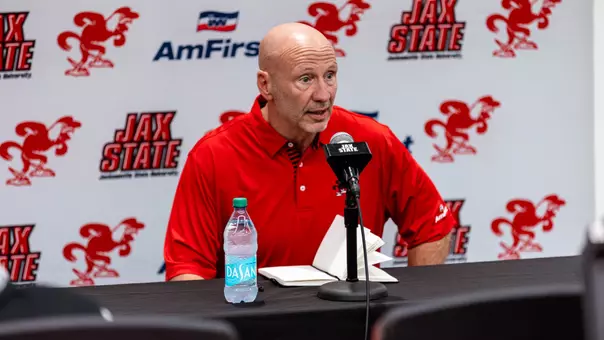
Coach Charles Kelly
Q: You guys are coming off of a big homecoming win last week against Sam Houston. Maybe one of the more complete efforts you guys have had throughout the year.
A: I mentioned after the game, I'm very proud of our players. Yeah, we're proud of the result, but I'm a lot more proud of the preparation that went in to get the result. I think our guys have learned that it takes discipline, preparation, and consistency to play a complete game. And listen, we had tons of mistakes in that game that we got to be able to fix and get better as we go throughout the rest of the season.
Q: Your opponent this week is one where the last couple times these two teams have met, it's come down to a field goal in the final minute in the three in the last three regular season contests. Give us your scout on Tyson (Helton's) squad.
A: Well, first of all, Tyson Helton is a really good coach. He and I have had opportunities to work together. We will see as much stuff on the offense against them as we have against anybody. I mean they do a lot of stuff, and he's a good coach. I mean, his fingerprints are all over the offense. A little bit similar to Clay (Helton), they do a really good job of going out there and finding the explosive plays that have hurt you in the past and dressing them up and finding a way to do that. So that's why it's so important for us to correct our mistakes as we go along through the season, because we got to fix those things that have given us problems. But they've got two talented quarterbacks. I mean, you know, Brock (Glenn) is a really good athlete. He can throw the ball. He can run the ball. Rodney (Tisdale), we played against him last year. I mean, he's one of the better young quarterbacks that I've seen. They got good receivers. They're running the ball better. They're very active on defense. You know, do a lot of movement. Try to create problems. And Jonathan Stafford. I mean, he's a really good receiver, but he's a good return guy too, so we got to be sound in the kicking game, be able to you know be focused for six seconds at a time and do our job.
Q: The new CFP format came out at 24 teams. Doesn't seem like there's any extra spot for the Group of Six. Kind of what are your thoughts on that?
A: I think there may be some advantages for us in scheduling. You know, that that's the advantage that I see. It's unfortunate that it's going to be the only sport in NCAA that doesn't take a conference champion. All other sports conference champions have an opportunity to compete in a championship tournament. Why we came up with that, I don't know. All of this is about money. It's all about money. So it's not about competition. It's about money. And you know, at the end of the day, if people realize that, then it is what it is. But as far as creating an advantage for another G6 team to get in, you know what I've always said since I've been here, if you win them all, you take you take that out of it. It gives you a chance if you win them all. But that's the path that I see for a G6 team to get in. But you know, hopefully, maybe down the road we'll look at it like we do basketball, baseball, softball, and say, you know what? Conference champions deserve an opportunity to compete for a championship. That's what this country's about.
Q: If you win this one on Saturday, you go the conference championship game. Is that something you personally think about
A: You know what, I appreciate you letting me know that because I had no idea. Had no idea. Honestly truth that I had no idea and in all due respect absolutely not. When I was in school when I played for Coach (Pat) Dye at Auburn. We got down to the last stretch. You guys have probably heard me say this before, but we got down to the last stretch of the season. And back then, the schedule was the same every year. We finished up the season with Florida, Georgia, and Alabama. That was our last three games, and Coach Dye referred to it as Amen Corner, like in the Masters. And what we look at is we're focusing on every shot that we gotta make right now. We're not focused on championship talk. We're focused on preparing like a champion, because what happens is when you start looking at those outcomes and worried about the outcome, that's how people lose the Masters. They're worried about winning the tournament instead of the next shot, and the guys that have won more times than not focus on the next shot. So that's what we're trying to do.
Q: Could you talk defensively? I think 30th in the country in total defense. Defense quietly done a really good job this year. Could you talk about why that is?
A: Our coaching staff would tell you this too. We have improved in a lot of areas. We've tackled better. We've created more pressure on the quarterback. But you know, playing good on defense is a team effort. It is a team effort. How you prepare throughout the season, people talk about we want to play good defense. Well, that goes back. You can't cure that in a week. That's how you prepare and start in January. And it's what you do in practice against your offense. And then our offense does a good job of maintaining drives, converting on third down, creating explosive plays. So most of the time, when people play really good defense, it's because it's complementary football. The kicking game helps the defense with the field position. I mean, we won the field position battle in special teams a lot of times, and that's not to take anything away from our defensive players or our defensive coaches. But it is always a team effort. Sometimes you go out there, and the offense is going to have to play better to win the game. Sometimes the defense has got to play better to win the game. Sometimes it's the kicking game, but it all kind of works together, and I think everybody because they want instant gratification, they want this magic dust to put on there and say let's play great defense. Well, you gotta live that way, and you gotta live that way in your whole organization, or it just doesn't work. So I think the complementary way we play together is, and I think our players understand that. I think they know the way we practice. That's you know we emphasize. When I first took this job, everybody says, "Oh, you're a defensive coach." No, I'm the head coach. I want the offense to be good. I want the defense to be good, and I want the kicking game to be good. But being able to prepare all those three phases has to go together.
Q: When we saw Jamill Williams back after his first big game, he seemed to be pretty soft-spoken postgame. But this past week, we kind of saw a different side of him when he was talking about his kickoff return. Can you just talk about kind of the confident side of him?
A: First of all, he is a great young man, you can be a great person and have a lot of confidence. I mean, the greatest player, one of the greatest football players I've ever known and ever watched was Deion Sanders. He had as much confidence as any person that I've ever been around. But he's also one of the best people that I've ever been around. You can be both, and you know Jamill has a lot of confidence, and there's nothing wrong with when you're a competent person of wanting the ball in your hands. I always want athletes that, whether it's the end of the game and it's a defensive player, hey, throw it at me so I can make a play. Kick it to me so I can make a play. Give me the ball so I can make the shot. Let me be up with two runners on to drive them in. That that's what competitors are, and you can tell by that not only is he competent, but he is a true competitor.
Q: WKU using two quarterbacks. How much does that make the defense have to prepare for that? But also, just kind of what challenges, knowing like the tendencies and all that, knowing like if he's in, they're going to do this. Just how much more does that bring to the game?
A: It does. Very good question because both guys are very talented, but they do some different things when both those guys are in there. So I think it's really important that our guys understand from their film study and the things that, because you can't practice everything. You only are you have limited amount of time. So a lot of it goes based off of what we see on video and study and tendencies, you know, both guys are very capable. Both guys are very athletic. You know, Brock's a little bit bigger guy, so it's been a little bit more quarterback run with him. But, Rodney's a guy that he's very athletic too. He can throw the football, but he can hurt you with his legs. They do some, so that does present a challenge for us.
Q: You mentioned being a defensive guy, but you're also a special teams guy. You've had a punt return for a touchdown. You've had a kickoff return for a touchdown. A lot of hidden yards to help in field position in those two areas. What have been some of the keys to success on special teams for you guys?
A: Well, first of all, I think we got the top special teams coordinator in the country and one of the best football coaches that I've ever been around, Max Thurmond. I mean, and I'd say that about every one of our position coaches and coordinators. I love them, but Max has done an incredible job. I mean, I would put him up against anybody, and he's very passionate about it. He does a very good job of evaluating and finding the right people to put in the right spots, and then we make it important. Our position coaches, our coordinators, our players will tell you, that's how our travel squad is decided. It's based off of who can play special teams. Has nothing to do with anything else. If you can't play special teams, it's hard for me. I've always thought this. It's hard for me to understand how I could have a guy that could be a starter at an FBS level, coaching the secondary, linebackers, but he can't play special teams. You know, when I was at when I was at Florida State in 2013, you know, Telvin Smith, Jalen Ramsey, Lamarcus Joyner. I mean, I could go on and on. Carlos Williams, our tailback. I mean, I can name all these guys. They were great special teams players. So I think Max does a good job. And our players play hard. We have good return guys and they have confidence. I think every time we're on punt return, our punt return team plays a little better because know, that Caleb (Nix) is going to try to return it for a touchdown. Same thing on kickoff return. I think our guys, because they know, hey, our guys get the ball in their hands, they can make something happen. But I think it all starts with leadership, and I think, you know, Max has done an incredible job.
TE Jameson Scissum & SAF Brennan Core

Q: Walk us through your development from your freshman year, now getting into pretty much a pretty constant rotation at that tight end position, and like Coach alluded to on special teams.
JS: I felt like it was just slow kind of trying to learn the position. I played quarterback in high school, so it was definitely a little learning curve. So, I felt like though Coach (Taylor) Housewright kind of brought me in and took me under his wing, and kind of showed me, and I also had very good guys to look up to, such as Pearson(Baldwin) and Harrison (Hamsley), and I felt like I kind of learned quick, but at the same time, it was a slow process. You know, playing tight end is hard. It's really like another quarterback. You got to know what everybody's doing, and I felt like you know it's been a really big developmental piece. Would be me like I would say taking it a day at a time and knowing that I don't have to do everybody's job. I just have to do my job, and it's kind of made me do who I am today.
Q: Take us through Saturday. All of a sudden, they come to you and say, "Hey, you're going to be our number one safety. Had a great game. Led the team in tackles with seven. What was Saturday like for you?"
BC: It was really a blur. It happened so fast. You know, our starting safety Rob Billings went down in warmups. You know, never want that to happen. But you know, it's the next man up mentality. You got to do what you got to do. It's a standard here at Jacksonville State. You got to live up to that standard.
Q: What goes through your head there, what do you have to do? What's going through your head? How do you prepare to make that switch?
BC: Like Coach Kelly said, the way we prepare all week, I'm pretty sure everybody, even no matter who's not gonna play, who's gonna play, they prepare like starters. So I'm pretty sure if anybody would have got put in that situation, they would have been able to do the same thing.
Q: I notice you're kind of doing a lot of really good blocking there. Just kind of what has been the process to go from the quarterback who you know you were really good at avoiding contact when you could to now like you're seeking it out.
JS: It almost seems like really just a mindset, you know, getting hit, having a hit, you know, it kind of just creates a mindset. Well, if I'm gonna do this, I'm gonna do it the best I can, and so I feel like that's really just a testimony to this program. You know, we play that you're gonna be fast, physical, tough, but we do all that stuff, and so you know, once you buy in, you're kind of in, man. I feel like that's helped me along the way.
Q: Coach Kelly talked about it some about you guys seem to be pretty good at just kind of looking what's in front of you and not what could happen down the road.
JS: So I mean, we have a saying that six seconds at a time, so we kind of, you know, we've developed that and you know be where your feet are, and so we really focus on you know that's something that we'll have to focus on in the future. But as of right now, we're just gonna keep taking it one day at a time, one play at a time, and we're just gonna keep going from there.
Q: Kind of walk us through your development in the time that you've been here. What's this whole process been like for you?
BC: Yeah, you know, I didn't play safety until like my senior year of high school, so I was always an inside linebacker. But ever since I got here, you know, Coach (Quincy Kahlert), Coach Kelly, they all been really helpful. You know, trying to get me to become better in my position. Yeah, special teams. Coach, he's done a great job trying to just put me where I need to be, helping me get into the right opportunity so I can take advantage of him.
Q: What was the biggest, I guess, surprise as you go from high school football, all the success that you guys had there to college football. What's the biggest difference in your eyes making that transition?
BC: I come from a winning program, but I knew Jacksonville State was a winning program too when I was getting recruited by Coach Kelly. So he made sure to let me know that you know he wants to recruit winners so we can be winners.
Q: Your position group as a whole, four of you guys have kind of rotated in pretty regularly. All four of you, it seems like, kind of have different strengths. Can you kind of talk about how you guys work together and bring the best out of each other?
JS: It's really a testimony if you think about it. Like we started off in the spring, we were probably one of the weakest groups on the team. You know, it led to staying later at night to watch more film, whether it was to talk about plays or really, because we got a very young group. And I mean, it just shows how we've all bought into the program and that we don't take it lightly. That we want to be physical, but at the same time, we also all have our strengths. So, you know, whether it's running routes or blocking, like we're all pretty serious about that, and we all want to do just our job.
Q: You guys are coming off of a big homecoming win last week against Sam Houston. Maybe one of the more complete efforts you guys have had throughout the year.
A: I mentioned after the game, I'm very proud of our players. Yeah, we're proud of the result, but I'm a lot more proud of the preparation that went in to get the result. I think our guys have learned that it takes discipline, preparation, and consistency to play a complete game. And listen, we had tons of mistakes in that game that we got to be able to fix and get better as we go throughout the rest of the season.
Q: Your opponent this week is one where the last couple times these two teams have met, it's come down to a field goal in the final minute in the three in the last three regular season contests. Give us your scout on Tyson (Helton's) squad.
A: Well, first of all, Tyson Helton is a really good coach. He and I have had opportunities to work together. We will see as much stuff on the offense against them as we have against anybody. I mean they do a lot of stuff, and he's a good coach. I mean, his fingerprints are all over the offense. A little bit similar to Clay (Helton), they do a really good job of going out there and finding the explosive plays that have hurt you in the past and dressing them up and finding a way to do that. So that's why it's so important for us to correct our mistakes as we go along through the season, because we got to fix those things that have given us problems. But they've got two talented quarterbacks. I mean, you know, Brock (Glenn) is a really good athlete. He can throw the ball. He can run the ball. Rodney (Tisdale), we played against him last year. I mean, he's one of the better young quarterbacks that I've seen. They got good receivers. They're running the ball better. They're very active on defense. You know, do a lot of movement. Try to create problems. And Jonathan Stafford. I mean, he's a really good receiver, but he's a good return guy too, so we got to be sound in the kicking game, be able to you know be focused for six seconds at a time and do our job.
Q: The new CFP format came out at 24 teams. Doesn't seem like there's any extra spot for the Group of Six. Kind of what are your thoughts on that?
A: I think there may be some advantages for us in scheduling. You know, that that's the advantage that I see. It's unfortunate that it's going to be the only sport in NCAA that doesn't take a conference champion. All other sports conference champions have an opportunity to compete in a championship tournament. Why we came up with that, I don't know. All of this is about money. It's all about money. So it's not about competition. It's about money. And you know, at the end of the day, if people realize that, then it is what it is. But as far as creating an advantage for another G6 team to get in, you know what I've always said since I've been here, if you win them all, you take you take that out of it. It gives you a chance if you win them all. But that's the path that I see for a G6 team to get in. But you know, hopefully, maybe down the road we'll look at it like we do basketball, baseball, softball, and say, you know what? Conference champions deserve an opportunity to compete for a championship. That's what this country's about.
Q: If you win this one on Saturday, you go the conference championship game. Is that something you personally think about
A: You know what, I appreciate you letting me know that because I had no idea. Had no idea. Honestly truth that I had no idea and in all due respect absolutely not. When I was in school when I played for Coach (Pat) Dye at Auburn. We got down to the last stretch. You guys have probably heard me say this before, but we got down to the last stretch of the season. And back then, the schedule was the same every year. We finished up the season with Florida, Georgia, and Alabama. That was our last three games, and Coach Dye referred to it as Amen Corner, like in the Masters. And what we look at is we're focusing on every shot that we gotta make right now. We're not focused on championship talk. We're focused on preparing like a champion, because what happens is when you start looking at those outcomes and worried about the outcome, that's how people lose the Masters. They're worried about winning the tournament instead of the next shot, and the guys that have won more times than not focus on the next shot. So that's what we're trying to do.
Q: Could you talk defensively? I think 30th in the country in total defense. Defense quietly done a really good job this year. Could you talk about why that is?
A: Our coaching staff would tell you this too. We have improved in a lot of areas. We've tackled better. We've created more pressure on the quarterback. But you know, playing good on defense is a team effort. It is a team effort. How you prepare throughout the season, people talk about we want to play good defense. Well, that goes back. You can't cure that in a week. That's how you prepare and start in January. And it's what you do in practice against your offense. And then our offense does a good job of maintaining drives, converting on third down, creating explosive plays. So most of the time, when people play really good defense, it's because it's complementary football. The kicking game helps the defense with the field position. I mean, we won the field position battle in special teams a lot of times, and that's not to take anything away from our defensive players or our defensive coaches. But it is always a team effort. Sometimes you go out there, and the offense is going to have to play better to win the game. Sometimes the defense has got to play better to win the game. Sometimes it's the kicking game, but it all kind of works together, and I think everybody because they want instant gratification, they want this magic dust to put on there and say let's play great defense. Well, you gotta live that way, and you gotta live that way in your whole organization, or it just doesn't work. So I think the complementary way we play together is, and I think our players understand that. I think they know the way we practice. That's you know we emphasize. When I first took this job, everybody says, "Oh, you're a defensive coach." No, I'm the head coach. I want the offense to be good. I want the defense to be good, and I want the kicking game to be good. But being able to prepare all those three phases has to go together.
Q: When we saw Jamill Williams back after his first big game, he seemed to be pretty soft-spoken postgame. But this past week, we kind of saw a different side of him when he was talking about his kickoff return. Can you just talk about kind of the confident side of him?
A: First of all, he is a great young man, you can be a great person and have a lot of confidence. I mean, the greatest player, one of the greatest football players I've ever known and ever watched was Deion Sanders. He had as much confidence as any person that I've ever been around. But he's also one of the best people that I've ever been around. You can be both, and you know Jamill has a lot of confidence, and there's nothing wrong with when you're a competent person of wanting the ball in your hands. I always want athletes that, whether it's the end of the game and it's a defensive player, hey, throw it at me so I can make a play. Kick it to me so I can make a play. Give me the ball so I can make the shot. Let me be up with two runners on to drive them in. That that's what competitors are, and you can tell by that not only is he competent, but he is a true competitor.
Q: WKU using two quarterbacks. How much does that make the defense have to prepare for that? But also, just kind of what challenges, knowing like the tendencies and all that, knowing like if he's in, they're going to do this. Just how much more does that bring to the game?
A: It does. Very good question because both guys are very talented, but they do some different things when both those guys are in there. So I think it's really important that our guys understand from their film study and the things that, because you can't practice everything. You only are you have limited amount of time. So a lot of it goes based off of what we see on video and study and tendencies, you know, both guys are very capable. Both guys are very athletic. You know, Brock's a little bit bigger guy, so it's been a little bit more quarterback run with him. But, Rodney's a guy that he's very athletic too. He can throw the football, but he can hurt you with his legs. They do some, so that does present a challenge for us.
Q: You mentioned being a defensive guy, but you're also a special teams guy. You've had a punt return for a touchdown. You've had a kickoff return for a touchdown. A lot of hidden yards to help in field position in those two areas. What have been some of the keys to success on special teams for you guys?
A: Well, first of all, I think we got the top special teams coordinator in the country and one of the best football coaches that I've ever been around, Max Thurmond. I mean, and I'd say that about every one of our position coaches and coordinators. I love them, but Max has done an incredible job. I mean, I would put him up against anybody, and he's very passionate about it. He does a very good job of evaluating and finding the right people to put in the right spots, and then we make it important. Our position coaches, our coordinators, our players will tell you, that's how our travel squad is decided. It's based off of who can play special teams. Has nothing to do with anything else. If you can't play special teams, it's hard for me. I've always thought this. It's hard for me to understand how I could have a guy that could be a starter at an FBS level, coaching the secondary, linebackers, but he can't play special teams. You know, when I was at when I was at Florida State in 2013, you know, Telvin Smith, Jalen Ramsey, Lamarcus Joyner. I mean, I could go on and on. Carlos Williams, our tailback. I mean, I can name all these guys. They were great special teams players. So I think Max does a good job. And our players play hard. We have good return guys and they have confidence. I think every time we're on punt return, our punt return team plays a little better because know, that Caleb (Nix) is going to try to return it for a touchdown. Same thing on kickoff return. I think our guys, because they know, hey, our guys get the ball in their hands, they can make something happen. But I think it all starts with leadership, and I think, you know, Max has done an incredible job.
TE Jameson Scissum & SAF Brennan Core
Q: Walk us through your development from your freshman year, now getting into pretty much a pretty constant rotation at that tight end position, and like Coach alluded to on special teams.
JS: I felt like it was just slow kind of trying to learn the position. I played quarterback in high school, so it was definitely a little learning curve. So, I felt like though Coach (Taylor) Housewright kind of brought me in and took me under his wing, and kind of showed me, and I also had very good guys to look up to, such as Pearson(Baldwin) and Harrison (Hamsley), and I felt like I kind of learned quick, but at the same time, it was a slow process. You know, playing tight end is hard. It's really like another quarterback. You got to know what everybody's doing, and I felt like you know it's been a really big developmental piece. Would be me like I would say taking it a day at a time and knowing that I don't have to do everybody's job. I just have to do my job, and it's kind of made me do who I am today.
Q: Take us through Saturday. All of a sudden, they come to you and say, "Hey, you're going to be our number one safety. Had a great game. Led the team in tackles with seven. What was Saturday like for you?"
BC: It was really a blur. It happened so fast. You know, our starting safety Rob Billings went down in warmups. You know, never want that to happen. But you know, it's the next man up mentality. You got to do what you got to do. It's a standard here at Jacksonville State. You got to live up to that standard.
Q: What goes through your head there, what do you have to do? What's going through your head? How do you prepare to make that switch?
BC: Like Coach Kelly said, the way we prepare all week, I'm pretty sure everybody, even no matter who's not gonna play, who's gonna play, they prepare like starters. So I'm pretty sure if anybody would have got put in that situation, they would have been able to do the same thing.
Q: I notice you're kind of doing a lot of really good blocking there. Just kind of what has been the process to go from the quarterback who you know you were really good at avoiding contact when you could to now like you're seeking it out.
JS: It almost seems like really just a mindset, you know, getting hit, having a hit, you know, it kind of just creates a mindset. Well, if I'm gonna do this, I'm gonna do it the best I can, and so I feel like that's really just a testimony to this program. You know, we play that you're gonna be fast, physical, tough, but we do all that stuff, and so you know, once you buy in, you're kind of in, man. I feel like that's helped me along the way.
Q: Coach Kelly talked about it some about you guys seem to be pretty good at just kind of looking what's in front of you and not what could happen down the road.
JS: So I mean, we have a saying that six seconds at a time, so we kind of, you know, we've developed that and you know be where your feet are, and so we really focus on you know that's something that we'll have to focus on in the future. But as of right now, we're just gonna keep taking it one day at a time, one play at a time, and we're just gonna keep going from there.
Q: Kind of walk us through your development in the time that you've been here. What's this whole process been like for you?
BC: Yeah, you know, I didn't play safety until like my senior year of high school, so I was always an inside linebacker. But ever since I got here, you know, Coach (Quincy Kahlert), Coach Kelly, they all been really helpful. You know, trying to get me to become better in my position. Yeah, special teams. Coach, he's done a great job trying to just put me where I need to be, helping me get into the right opportunity so I can take advantage of him.
Q: What was the biggest, I guess, surprise as you go from high school football, all the success that you guys had there to college football. What's the biggest difference in your eyes making that transition?
BC: I come from a winning program, but I knew Jacksonville State was a winning program too when I was getting recruited by Coach Kelly. So he made sure to let me know that you know he wants to recruit winners so we can be winners.
Q: Your position group as a whole, four of you guys have kind of rotated in pretty regularly. All four of you, it seems like, kind of have different strengths. Can you kind of talk about how you guys work together and bring the best out of each other?
JS: It's really a testimony if you think about it. Like we started off in the spring, we were probably one of the weakest groups on the team. You know, it led to staying later at night to watch more film, whether it was to talk about plays or really, because we got a very young group. And I mean, it just shows how we've all bought into the program and that we don't take it lightly. That we want to be physical, but at the same time, we also all have our strengths. So, you know, whether it's running routes or blocking, like we're all pretty serious about that, and we all want to do just our job.
Players Mentioned
Tuesday, November 10
Sunday, November 08
Tuesday, November 03
Friday, October 23